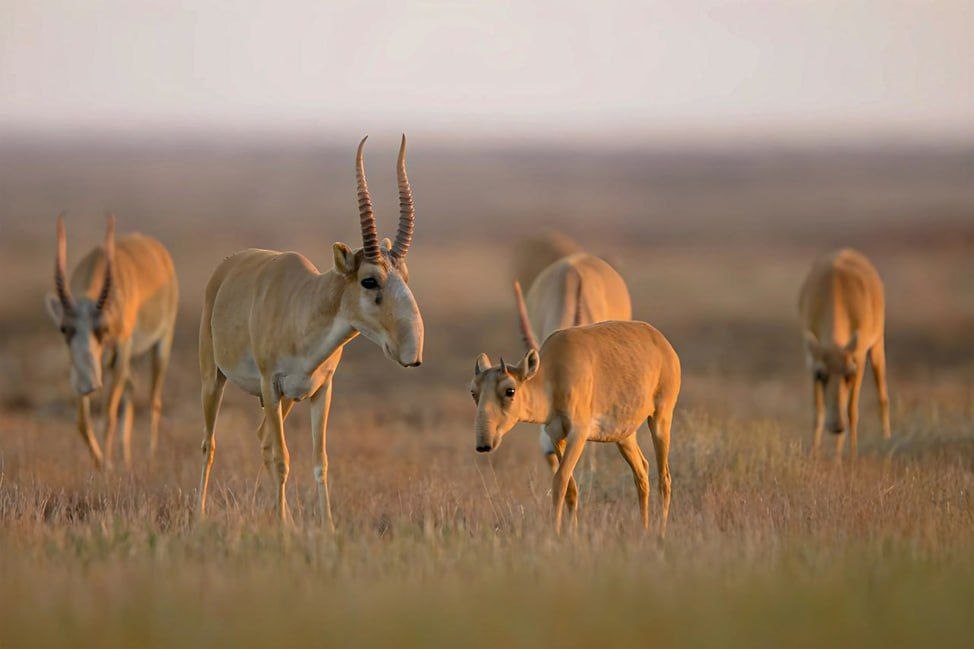
SAIGA: THE AMAZING STEPPE ANTELOPE
The saiga antelope, is a graceful and incredibly fast steppe antelope with a remarkable appearance. With its unique trunk-like nose, it is unlike any other member of its genus. This fascinating animal first appeared on Earth 50,000 to 70,000 years ago, surviving the era of mammoths and maintaining its essence to this day. However, such a long and rich history does not protect the saiga from modern threats: this species is considered endangered. Unfortunately, in today's world, its population is rapidly declining due to habitat loss, poaching, and climate change. The expansion of agriculture, extraction of minerals, and other human activities lead to the destruction of the saiga's natural habitat, significantly reducing their numbers.
The saiga is not just an animal; it is a symbol of resilience that has overcome numerous challenges throughout its long history. Once, this magnificent species roamed the vast expanses of the Eurasian continent, and its remarkable ability to adapt to life in harsh steppes makes it a true embodiment of the wilderness. Today, the saiga faces serious threats, and its survival depends on efforts to protect and conserve this unique species.
In 2002, the International Union for Conservation of Nature (IUCN) classified this species as "CR," which stands for "Critically Endangered." In 2010, during a conference held as part of the "SOS Saiga" program, representatives from Kazakhstan, Uzbekistan, and Russia established May 5 as International Saiga Day. This day aims to raise awareness of the conservation issues facing the saiga and to promote efforts for its protection.
The rare saiga antelope is listed in the Red Data Book of Uzbekistan, the IUCN Red List, and in CITES Appendix II (the Convention on International Trade in Endangered Species of Wild Fauna and Flora). These measures are aimed at protecting the saiga from poaching and creating conditions for its recovery in its natural habitat. The conservation of this unique animal is of immense importance not only for biodiversity but also for maintaining the ecosystem in which it lives.
In 2016, to restore the saiga population, a comprehensive (landscape) protected area called "Saiga" was established in the Muynak and Kungrad districts of Karakalpakstan, covering a total area of 848.1 thousand hectares, including a protected zone of 219.8 thousand hectares.
A Memorandum of Understanding on the conservation, restoration, and sustainable use of saigas has been signed between Uzbekistan and Kazakhstan, along with an intergovernmental agreement for their protection and reproduction.